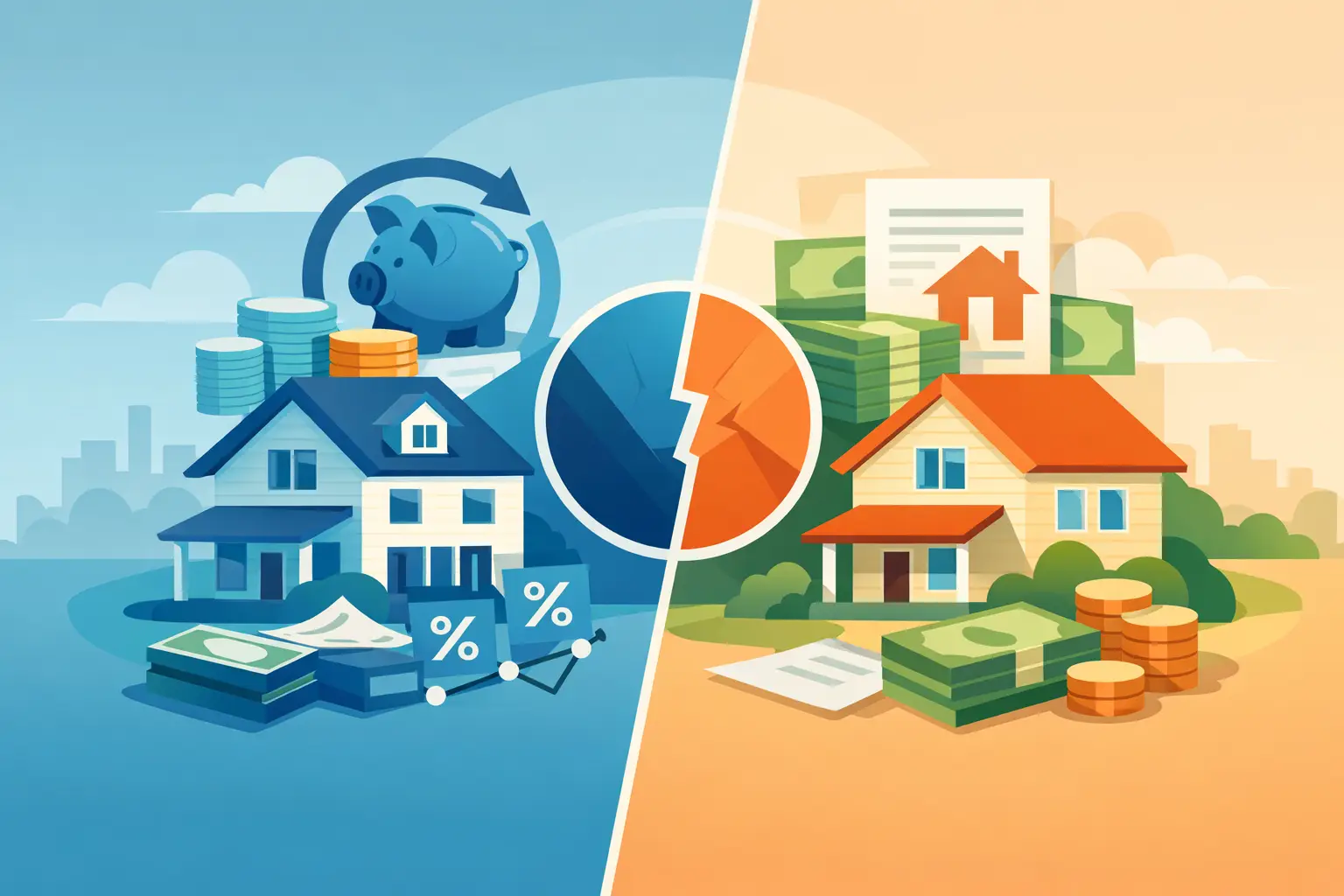
A kitchen renovation estimate, a tuition bill, or high-interest credit card debt can make your home equity look like an obvious source of cash. But choosing a HELOC versus home equity loan is not just about how much you can borrow. It is about how predictable you need your payment to be, when you need the money, and how comfortably your budget can handle change.
Both options let eligible homeowners borrow against the value they have built in their home. Both put your home on the line if you cannot repay. The difference is in how the money is delivered and how repayment works. Knowing that difference before you apply can keep a useful financial tool from becoming an expensive surprise.
HELOC versus home equity loan: the core difference
A home equity loan gives you one lump sum of money. You repay it in regular monthly installments over a set term, often with a fixed interest rate. If you borrow $50,000, you receive $50,000 at closing and begin paying back principal and interest right away.
A home equity line of credit, usually called a HELOC, works more like a credit line secured by your home. Your lender approves a maximum limit, but you can borrow from that limit as needed during a draw period. You only pay interest on the amount you have actually used, not the full approved amount.
That structural difference shapes nearly every part of the decision. A home equity loan generally favors certainty. A HELOC generally favors flexibility.
| Feature | HELOC | Home Equity Loan | |—|—|—| | How funds are received | Borrow as needed up to a limit | One lump sum at closing | | Interest rate | Usually variable | Often fixed | | Payment | Can change as rates or balance change | Usually predictable monthly payment | | Best for | Costs that happen over time or are uncertain | A known, one-time expense | | Access after closing | Available during the draw period | No additional access without a new loan |
When a HELOC may make more sense
A HELOC can work well when you do not know exactly how much you will need or when expenses will arrive. A multi-stage home renovation is a common example. You may need one payment for demolition, another for materials, and another after a contractor completes the next phase. Borrowing only what you need as those bills come due can reduce the interest you pay compared with taking a large lump sum upfront.
A HELOC can also be helpful as a planned backup for a major but uncertain expense, such as repairs after storm damage or a temporary gap between selling one home and buying another. The key word is planned. A line of credit is not free money simply because you have not drawn from it yet.
Most HELOCs have two phases. During the draw period, which may last several years, you can access funds and may have the option of making interest-only payments. That lower initial payment can be appealing, but it can hide the real cost of the debt. When the draw period ends, the repayment period begins. You can no longer borrow from the line, and your payment may rise sharply because you must repay principal as well as interest.
There is also rate risk. Most HELOCs have variable rates, meaning your rate and payment can rise if market rates rise. Some lenders offer fixed-rate conversion options for part or all of a HELOC balance, but terms vary. Ask how often the rate can change, whether there is a rate cap, and what your payment could look like at the highest possible rate.
When a home equity loan may be the better fit
A home equity loan is often the clearer choice when your expense has a defined price tag. Think of paying for a completed renovation contract, consolidating a known amount of high-interest debt, or covering a major medical expense with a set balance.
The biggest advantage is predictability. With a fixed-rate home equity loan, you know the monthly principal-and-interest payment from the beginning. That makes it easier to build the payment into your household budget and avoid the uncertainty that comes with a variable-rate line of credit.
The trade-off is that you start paying interest on the full loan amount immediately, even if you do not need every dollar on day one. Taking more than you truly need can also create a temptation to use the extra cash for spending that does not improve your financial position.
A fixed payment does not mean the loan is automatically low-cost. Compare the annual percentage rate, closing costs, repayment term, and total interest over the life of the loan. A longer term may make the payment more comfortable, but it can add substantially to the total interest paid.
Start with equity, not the advertised rate
Before comparing lender offers, get a realistic picture of your available equity. Equity is the difference between your home’s current market value and the mortgage balances secured by it.
For example, if your home is worth $400,000 and you owe $250,000 on your first mortgage, you have $150,000 in total equity. That does not mean you can borrow all $150,000. Lenders commonly limit the combined amount of your first mortgage plus the new loan or line to a percentage of your home’s value. This is called the combined loan-to-value ratio, or CLTV.
If a lender allows an 85% CLTV, the maximum total debt against a $400,000 home would be $340,000. With a $250,000 first-mortgage balance, that could leave up to $90,000 available before considering lender requirements and your financial profile.
Your credit score, income, employment, monthly debts, property type, and appraisal all matter. A strong equity position helps, but it does not guarantee approval or the best available terms. Lenders want to see that you can handle the payment, including a higher potential payment on a variable-rate HELOC.
The risk people should take seriously
A HELOC and a home equity loan are secured by your home. If financial hardship makes repayment impossible, foreclosure is a potential consequence. That does not mean either option is inherently bad. It means the purpose of the borrowing should be worth the risk.
Using home equity to replace high-interest credit card debt can lower your interest rate and simplify payments. But it does not solve the underlying problem if new card balances build back up. You may have turned unsecured debt into debt secured by your home without improving your spending plan.
It is also wise to consider your larger mortgage picture. If you expect to sell within a few years, move for work, retire on a lower income, or apply for another mortgage soon, an added home equity payment may limit your options. Selling the home generally means paying off the home equity loan or HELOC from the sale proceeds.
Tax treatment may come up in your research, but do not make the decision based on a tax assumption. Interest may be deductible in certain situations when funds are used to buy, build, or substantially improve the home securing the loan and you itemize deductions. Personal uses, such as paying off credit cards or funding a vacation, generally do not receive the same treatment. A qualified tax professional can help with your specific situation.
How to choose between a HELOC and a home equity loan
Start with the purpose and timing of the money. If you need a specific amount for a one-time expense and want a steady payment, a home equity loan is often easier to manage. If costs will occur gradually, are uncertain, or may never materialize, a HELOC can provide useful access without requiring you to borrow the full amount upfront.
Then pressure-test the payment. For a HELOC, ask the lender to show your payment at the current rate, at a higher rate, and after the draw period ends. For a home equity loan, look beyond the monthly payment and ask how much interest you will pay over the full term. In either case, leave room in your budget for home repairs, insurance increases, property taxes, and ordinary life expenses.
Finally, compare written loan estimates and disclosures carefully. Look for annual fees, appraisal fees, closing costs, early closure fees, minimum draw requirements, prepayment penalties, and whether the lender can freeze or reduce a HELOC under certain conditions. A low introductory rate or low initial payment is only one part of the offer.
Borrowing against your home can support a meaningful goal, but the best choice is the one your future budget can carry comfortably. Give yourself time to run the numbers, define the purpose of every dollar, and choose the option that brings more stability to your plan, not more pressure.
Leave a Reply