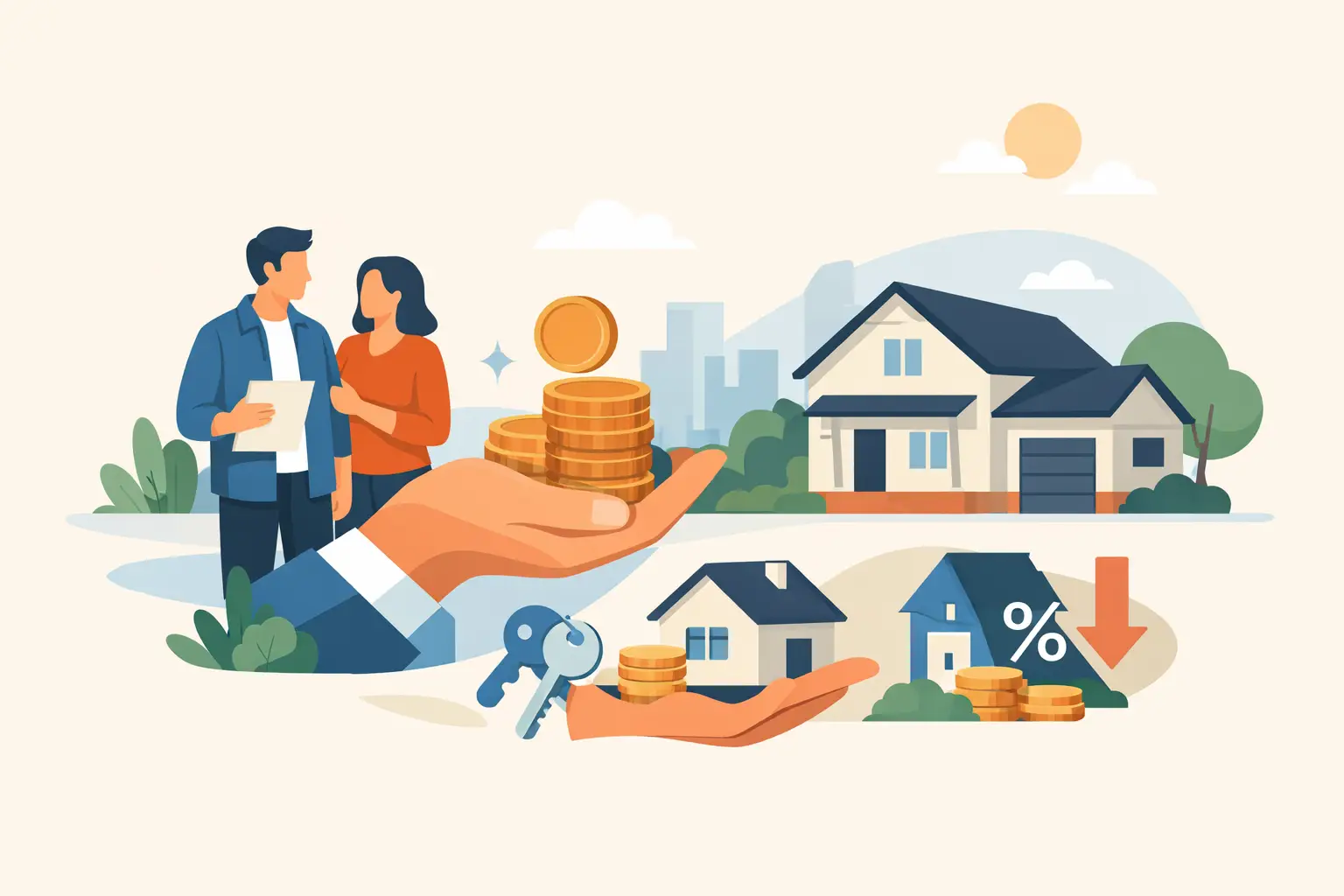
A buyer with $12,000 saved may be closer to owning a home than they think. The best low down payment loans can reduce the cash you need at closing, but the smallest down payment is not automatically the least expensive or best-fitting choice. The right option depends on your credit, income, property location, military eligibility, monthly budget, and how long you expect to keep the home.
A down payment is only one part of the homebuying equation. You will also need to account for closing costs, prepaid taxes and insurance, moving expenses, and a financial cushion after you get the keys. The goal is not to stretch every available dollar to buy a home. It is to choose financing that lets you buy with confidence and still handle real life after closing.
What Makes a Low Down Payment Loan a Good Choice?
A low down payment mortgage can be a smart tool when it helps you buy sooner without creating a monthly payment that feels uncomfortably tight. It can also allow you to keep some savings for repairs, emergencies, or closing costs instead of placing all your cash into the house.
The trade-off is that smaller down payments often come with mortgage insurance, higher interest rates, or program-specific fees. Those costs are not necessarily a reason to avoid the loan. They simply need to be part of the comparison.
For example, putting 3% down instead of 10% may help you buy years earlier in a market where home prices are rising. On the other hand, waiting to save more could lower your monthly payment and give you more negotiating room. There is no universal winner. Your timing, finances, and comfort level matter.
Best Low Down Payment Loans to Compare
Conventional loans with 3% down
A conventional loan is a mortgage that follows guidelines set by Fannie Mae or Freddie Mac. Many first-time buyers can qualify with as little as 3% down, and some repeat buyers may qualify with 5% down.
This can be one of the strongest options for buyers with good credit, reliable income, and manageable existing debt. Conventional mortgage insurance is typically required when you put down less than 20%, but it can usually be removed once you reach enough equity through payments, appreciation, or both. That removal feature can make conventional financing especially attractive for buyers planning to stay in the home for several years.
Credit score plays a meaningful role here. A buyer with stronger credit may receive a better rate and lower mortgage insurance cost than someone with a weaker profile. If your score needs work, improving it before applying can change the math more than you might expect.
FHA loans with 3.5% down
FHA loans are insured by the Federal Housing Administration and are designed to make homeownership more accessible for borrowers who may not fit conventional standards as easily. They generally allow a 3.5% down payment for borrowers who meet credit requirements.
FHA can be helpful if you have a lower credit score, a thinner credit history, or a higher debt-to-income ratio. It may also be a practical path for a buyer whose income is solid but whose credit recovery is still in progress.
The key cost to understand is mortgage insurance. FHA loans usually include an upfront mortgage insurance premium and an annual premium paid through the monthly mortgage payment. For many borrowers who put down less than 10%, that monthly insurance remains for the life of the loan unless they later refinance into another mortgage.
That does not make FHA a bad deal. It makes it a loan worth evaluating with a longer-term plan. A buyer may use FHA to purchase now, then refinance later if their credit improves, their income rises, or they build enough equity to make conventional financing more favorable.
VA loans with no down payment
For eligible veterans, active-duty service members, and certain surviving spouses, a VA loan can be one of the best low down payment loans available because it may require no down payment and no monthly mortgage insurance.
VA financing is backed by the Department of Veterans Affairs, but private lenders make the loans. Borrowers typically pay a VA funding fee unless they qualify for an exemption. The fee can often be financed into the loan balance, which reduces upfront cash needs but increases the amount borrowed.
VA loans can offer competitive interest rates and flexible underwriting. Still, eligibility does not mean every home or every budget is a match. You should consider the total payment, property taxes, insurance, and the condition of the home just as carefully as you would with any other mortgage.
USDA loans with no down payment
USDA loans can provide 100% financing for eligible buyers purchasing in designated rural and many suburban areas. The name can be misleading. These loans are not limited to farmland or remote communities. Many smaller towns and outer suburbs may qualify.
USDA financing is intended for borrowers with low to moderate incomes, and both household income limits and property-location rules apply. The program also has fees, including an upfront guarantee fee and an annual fee that is generally paid monthly.
If you are open to living outside a major city center, USDA is worth checking before you assume a down payment is your biggest obstacle. The location requirement is the deciding factor for many buyers, while the income limits may rule out others.
Down payment assistance paired with a mortgage
Down payment assistance is not one mortgage program. It is a category of local, state, nonprofit, employer, and housing-agency programs that may provide grants, forgivable loans, deferred-payment loans, or second mortgages to help cover your down payment and sometimes closing costs.
Assistance can be paired with FHA, conventional, VA, or USDA financing, depending on the program rules. Some options are geared toward first-time buyers, but “first-time” often means you have not owned a home in the past three years. Others focus on income levels, specific occupations, targeted neighborhoods, or community revitalization.
Read the terms carefully. A grant generally does not need to be repaid if you meet the rules. A forgivable loan may disappear after you live in the home for a required period. A deferred loan might not require monthly payments but could become due when you sell, refinance, rent out the property, or pay off the first mortgage. Assistance is valuable, but it is still part of your financing plan, not free money without conditions.
Look Beyond the Down Payment
Two buyers can make the same 3% down payment and have very different monthly costs. Interest rate, mortgage insurance, property taxes, homeowners insurance, homeowners association dues, and loan fees all affect affordability.
Ask for a comparison that shows the full monthly payment and the cash required to close for each option. Then ask how the numbers could change if you put 3%, 5%, or 10% down. This gives you a clearer picture than comparing advertised rates alone.
It also helps to think about your likely timeline. If you expect to move again in three years, paying extra upfront to reduce a long-term cost may not deliver much benefit. If this is a home you hope to keep for a decade, a loan with removable mortgage insurance or a lower rate may be worth more careful planning.
How to Choose the Right Program for Your Situation
Start with the question lenders will eventually ask: what payment can you comfortably manage every month? Use a number that leaves room for savings, retirement contributions, childcare, transportation, and the occasional home repair. Approval is not the same as affordability.
Next, review your credit and debt picture. Buyers with strong credit often benefit from comparing conventional options first. Buyers rebuilding credit may find FHA more accessible. Eligible military borrowers should almost always compare VA financing. Buyers with qualifying income and a home search area that includes eligible locations should add USDA to the conversation.
Finally, separate your available cash into three buckets: down payment, closing costs, and reserves. A low-down-payment loan is most useful when it protects your financial stability, not when it leaves your bank account at zero. If a seller credit or down payment assistance could reduce your upfront cost, understand the rules before building your offer around it.
A Smart Next Step Before You Apply
Before choosing a loan, gather recent pay stubs, tax returns if applicable, bank statements, details on monthly debts, and a realistic estimate of your savings. Review your credit reports for errors and avoid opening new credit accounts or making large unexplained deposits while preparing for a mortgage.
Then compare loan scenarios based on your actual numbers, not a generic online calculator. Clear to Close: Your Mortgage Guide encourages buyers to treat pre-approval as a planning tool. A useful pre-approval conversation should show you what different loan choices mean for your cash, payment, and future flexibility.
The best loan is the one that gets you into a home without making the rest of your financial life harder to manage. A smaller down payment can be a strategic choice when you understand the costs, protect your reserves, and choose a payment you can live with comfortably.
Leave a Reply